
 Fashion & Wax
 Beauty & Hair
Kwanzaa: Origins and How to Celebrate It
Discover Kwanzaa, the Pan-African celebration created in 1966: its origins, the seven principles of the Nguzo Saba, its symbols, and how families celebrate it across the diaspora.
Every year, from December 26 to January 1, millions of people of African descent around the world celebrate Kwanzaa, a week-long observance dedicated to heritage, values, and the unity of the African diaspora community.
A Pan-African Celebration Born of the Civil Rights Era
Kwanzaa was created in 1966 by Maulana Karenga, an African-American professor and activist, during the height of the American civil rights movement. Its name comes from the Swahili phrase matunda ya kwanza, meaning "first fruits," a reference to traditional harvest celebrations found across many African cultures. Karenga wanted to give African Americans a cultural and spiritual celebration of their own, rooted in African values, with no religious dimension, that could be observed alongside existing end-of-year holidays. Since its creation, Kwanzaa has spread well beyond the United States and today brings together African-descended families in Canada, the Caribbean, the United Kingdom, and increasingly in France and the rest of Europe.
The Seven Principles of the Nguzo Saba
- Umoja (Unity) — The first night honors unity within the family, the community, and the African diaspora as a whole.
- Kujichagulia (Self-Determination) — This principle calls for defining oneself, speaking for oneself, and shaping one's own destiny rather than letting others do it.
- Ujima (Collective Work and Responsibility) — It emphasizes building and maintaining community together, sharing both problems and solutions.
- Ujamaa (Cooperative Economics) — This day encourages building and supporting shared businesses and economic ventures, notably by championing Black-owned enterprises.
- Nia (Purpose) — It is about collectively setting goals that contribute to the greatness and development of the community.
- Kuumba (Creativity) — This principle encourages doing as much as one can, in one's own way, to leave the community more beautiful and beneficial than it was inherited.
- Imani (Faith) — The final day celebrates faith in the people, in parents, teachers, leaders, and in the ultimate victory of righteousness.
The Symbols of Kwanzaa
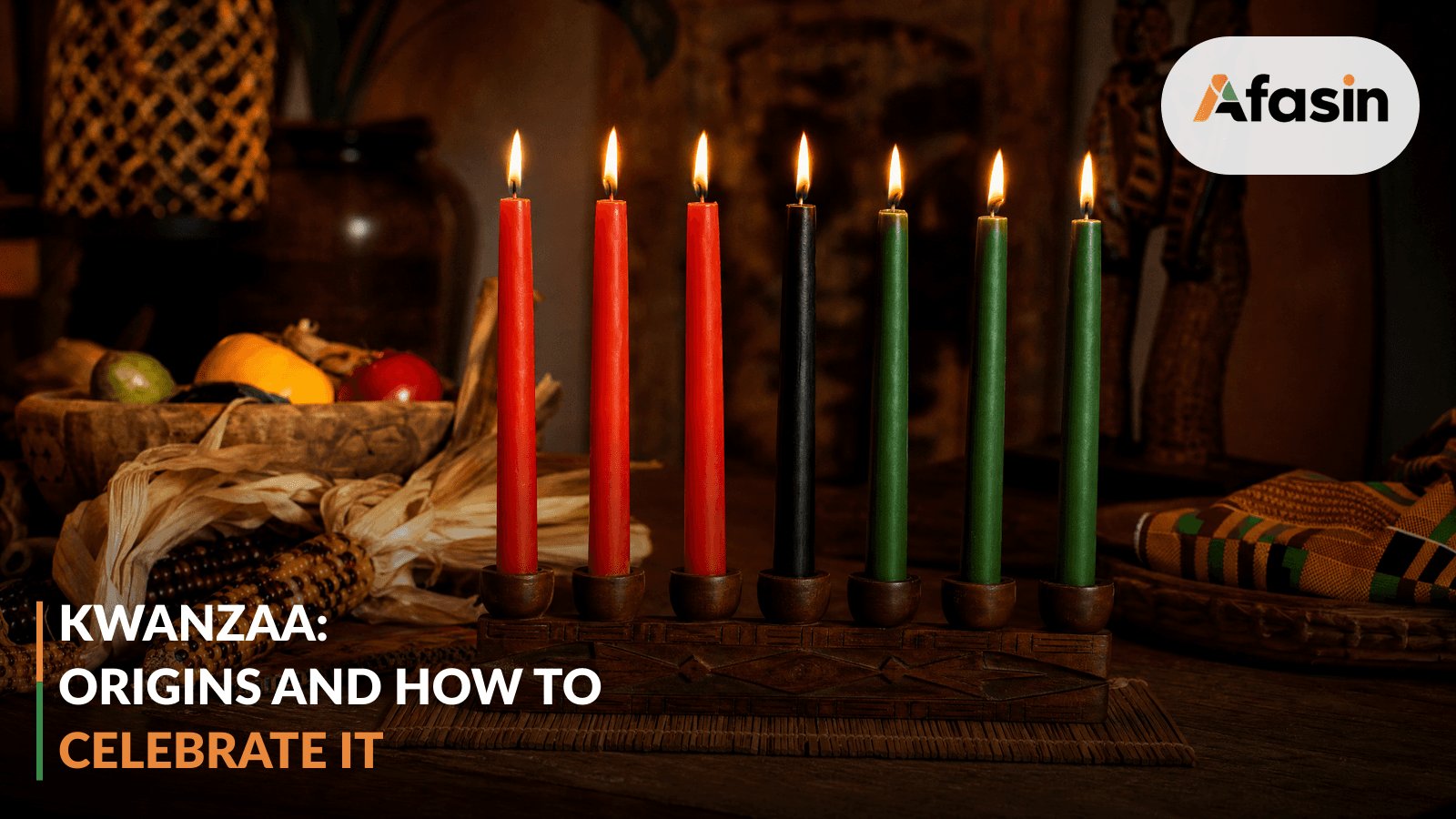
Every household observing Kwanzaa sets up a table or family altar bringing together several symbolic objects, arranged around the kinara, the celebration's central candleholder:
- Kinara — the seven-branched candleholder, the visual centerpiece of the celebration
- Mishumaa Saba — the seven candles (three red, three green, and one black in the center), representing the seven principles
- Mkeka — the mat, symbolizing the foundation, tradition, and history the community is built upon
- Muhindi — the ears of corn, representing the household's children and future generations
- Kikombe cha Umoja — the unity cup, shared among family members to honor ancestors
- Zawadi — the gifts, often handmade or culturally meaningful, given toward the end of the week
How Do Families Celebrate Kwanzaa?
Every evening from December 26 through January 1, the family gathers around the kinara to light an additional candle and discuss that day's principle, often through songs, storytelling, poetry, or family anecdotes. Children are especially included in these exchanges as part of an intergenerational transmission of values. December 31, the sixth day of the celebration, is marked by the karamu, a large communal feast where traditional dishes from Africa and the diaspora are shared in joy and togetherness. The week closes on January 1 with the principle of Imani, faith, looking ahead to the year to come.
Long seen as a strictly North American tradition, Kwanzaa is increasingly observed by African-descended communities across Europe, including in France, where cultural associations, families, and community groups organize evening gatherings, workshops, and markets around its values. Without replacing any existing holiday, it offers an additional moment of reconnection with African heritage and a chance to celebrate, together, unity, creativity, and pride in a shared culture.
Updated on 16 October 2026